
Table of Contents
- Why Preventive Maintenance Saves Money on Older Vehicles
- Build Your Older Car Maintenance Checklist
- High-Mileage Car Maintenance Schedule by Age and Mileage
- DIY Car Maintenance for Beginners: What You Can Handle Yourself
- When to Repair or Replace an Older Car: Making the Right Call
- Budget-Friendly Maintenance Strategies That Actually Work
- Strategy 1: Prioritize by safety, then by failure cost
- Strategy 2: Build a maintenance reserve
- Strategy 3: Use the owner’s manual, not a generic interval
- Strategy 4: Keep a maintenance log
- Strategy 5: Buy quality parts, but not the most expensive ones
- Strategy 6: Catch leaks and noises early
- Strategy 7: Get estimates in writing and compare
- Strategy 8: Do seasonal prep before the season
- Warning Signs That Demand Immediate Attention
- Frequently Asked Questions
Last Updated: October 17, 2026
Why Preventive Maintenance Saves Money on Older Vehicles
The biggest reason older vehicles fail is neglect: owners skip routine checks until something breaks, when the bill is triple what affordable car maintenance would have cost.
Preventive maintenance stops small problems before they become expensive ones.
Routine maintenance costs predictable amounts; emergency repairs hit suddenly. For older vehicles, preventive care is the difference between staying on the road and failing at the worst moment.
Build Your Older Car Maintenance Checklist
A solid checklist prevents missed tasks. Track monthly inspections, seasonal maintenance, and critical fluid replacements based on age and mileage.
Monthly and Seasonal Checks
Monthly checks take 15 minutes and catch problems early:
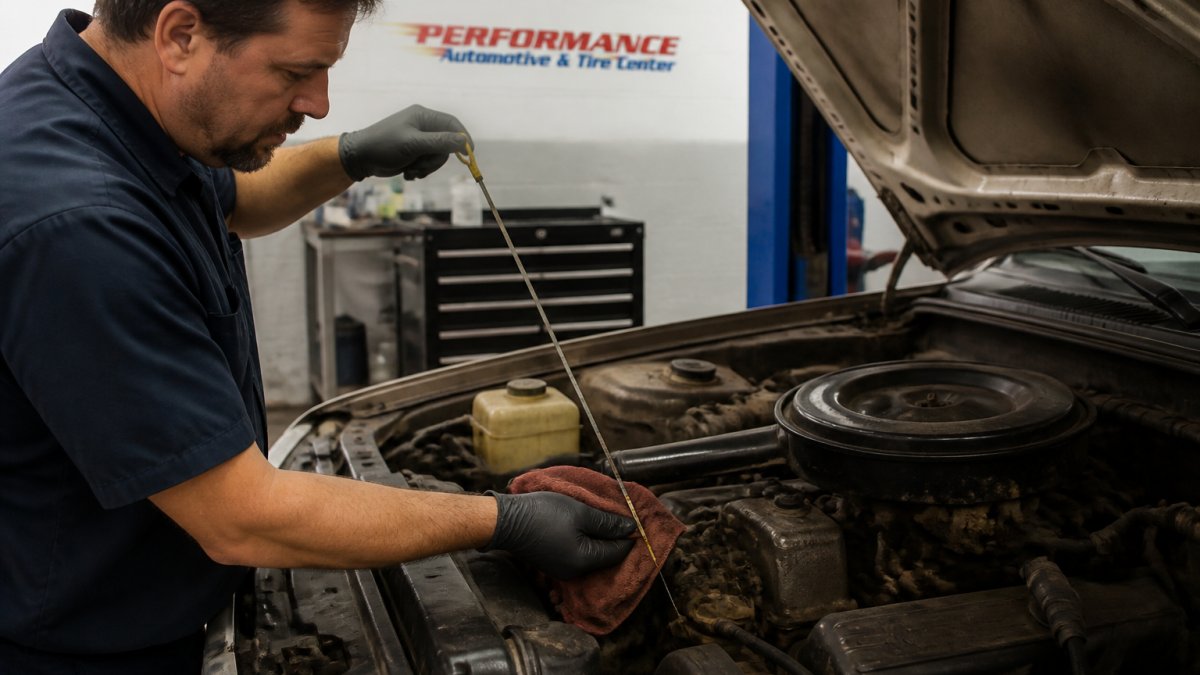
- Oil level – Check with the dipstick. Top up if low.
- Tire pressure and tread – Use a gauge. Look for uneven wear.
- Lights – Test headlights, brake lights, and turn signals.
Seasonal checks matter before major weather shifts:
- Before winter – Check battery strength, test heater and defroster, inspect wipers and wiper fluid.
- Before summer – Test air conditioning, check coolant level, inspect belts for cracks.
Critical Fluid and Filter Replacements
Your vehicle depends on clean fluids and filters. As your car ages, these replacements become more critical:
| Maintenance Item | Typical Interval | Why It Matters |
|---|---|---|
| Engine oil and filter | Every 3,000-5,000 miles | Prevents engine sludge and wear |
| Air filter | Every 12,000-15,000 miles | Improves fuel economy and engine health |
| Cabin air filter | Every 12,000-15,000 miles | Keeps interior air clean |
| Transmission fluid | Every 30,000-60,000 miles | Protects transmission from overheating |
| Coolant flush | Every 30,000-50,000 miles | Prevents rust and overheating |
| Brake fluid | Every 2 years or 30,000 miles | Maintains braking power and prevents corrosion |
| Fuel filter | Every 20,000-40,000 miles | Prevents fuel system clogging |
Older vehicles benefit most: as seals age and metal wears, fresh fluids protect against breakdown.
Keep a maintenance log. Write down every service date and mileage. This record proves you’ve cared for the vehicle and helps you spot patterns, like if your transmission fluid needs changing more frequently than normal.
High-Mileage Car Maintenance Schedule by Age and Mileage
Maintenance needs shift with age and mileage.
For vehicles 5-10 years old (50,000-100,000 miles):
Focus on wear and tear. Brake pads, wiper blades, and battery are likely due soon.
For vehicles 10-15 years old (100,000-150,000 miles):
Rubber components deteriorate: hoses, belts, and seals crack, battery life drops, and rust starts on the undercarriage. Brake fluid absorbs moisture and needs flushing more often.
For vehicles 15+ years old (150,000+ miles):
Everything ages faster: electrical gremlins, clogged injectors, failing catalytic converters, thinning undercoating. Budget for more frequent fluid and filter changes.
Older vehicles with high mileage can fail suddenly if maintenance is deferred. A cracked hose can leave you stranded. A worn brake pad can damage the rotor and double your repair cost. Do not skip checks on high-mileage cars.
DIY Car Maintenance for Beginners: What You Can Handle Yourself
Most guides hand you a task list and a vague warning to ‘see a professional’ for anything hard. The useful question is whether you have the tools, space, time, and tolerance for a mistake on that system. Sort each task into three buckets: do it yourself, do it yourself with a helper, or pay a professional.
The four-question test before you touch anything
Before any job, answer honestly:
- Do I own the required tool, or can I rent or borrow it for less than the shop’s labor charge? A torque wrench, jack, and jack stands are worth buying if you will use them more than twice. A scan tool that reads ABS and airbag codes usually is not.
- If I break something, is the vehicle still safe to drive to a shop? A stripped drain plug is an inconvenience. A cross-threaded brake caliper bolt is a safety failure.
- Does the job require lifting the vehicle and getting under it? If yes, you need rated jack stands on a flat, hard surface, plus wheel chocks. Never rely on a jack alone.
- Does the job touch a system with a warning light or a safety function? Brakes, steering, airbags, and high-voltage hybrid components are not beginner territory.
Bucket 1: Safe for most owners with basic tools
These need no lift, no special scanner, and a mistake is unlikely to be safety-critical:
- Check and top up fluids – Oil, coolant, brake fluid, power-steering fluid, and washer fluid. Use the dipstick or marked reservoir; a 10-minute check. Keep a funnel and rag in the trunk.
- Replace the engine air filter and cabin air filter – Most are held by clips or a few screws, often with no tools. A common pattern is $10-$30 for the part versus $50 or more at a shop.
- Replace wiper blades – Most clip or snap on in under five minutes per blade. Buy the length listed in the owner’s manual, not the longest blade that fits.
Bucket 2: Doable with a helper, a torque wrench, and patience
These are within reach for a careful owner, but require the right tools and a second set of hands:
- Tire rotation – Needs a jack, jack stands, wheel chocks, and a torque wrench. Rotate every 5,000-7,500 miles, or per the owner’s manual. Skipping rotation shortens tire life and can cost hundreds in premature replacement.
- Battery replacement – Usually a 10-15 minute job with a wrench, but you must transfer or reprogram memory settings on some vehicles. Check the owner’s manual for the radio code or relearn procedure.
- Serpentine belt replacement – Needs a belt-routing diagram (photograph the old one before removal) and the correct tensioner tool. A mistake here can leave you stranded, so do it at home, not on the road.
Bucket 3: Pay a professional
These require equipment, training, or a safety margin you cannot fake in a driveway:
- Brake pad and rotor replacement – Safety-critical. Requires lifting, torque specs, and brake-fluid handling. A mistake can cause a crash.
- Transmission fluid service – Many older vehicles require a specific fluid, a specific level-check procedure, and sometimes a scan tool to monitor temperature. The wrong fluid can ruin a transmission.
- Coolant flush – Requires capturing and disposing of old coolant, burping the system, and matching the correct coolant chemistry. Mixing coolant types can cause corrosion.
Before any DIY job, photograph the area you are about to work on. The photo gives you a reference for routing belts, hoses, and connectors, and it helps a shop diagnose the problem if you get stuck.
The goal is not to become a mechanic. The goal is to handle the low-risk, high-frequency checks yourself so you can spend your money on the jobs that actually need a professional. If a job fails the four-question test, pay for it. A wrong DIY fix usually costs more than the professional job would have.
When to Repair or Replace an Older Car: Making the Right Call
Every owner eventually faces the question: fix it or sell it? The answer depends on repair costs, condition, and budget.
Repair if:
- The repair costs less than 50% of the vehicle’s current market value
- The vehicle has been well-maintained and runs reliably overall
- You plan to keep the car for at least 2 more years
Consider replacing if:
- Repair costs exceed 50% of market value
- Multiple major systems are failing (transmission, engine, frame rust)
- The vehicle has been neglected and repairs keep stacking up
A reliable rule: add up all repairs needed in the next 12 months. If that total exceeds half the car’s value, replacement makes financial sense.
Call us at 480-924-7444 today! →
At Performance Automotive and Tire Center, our ASE-certified technicians evaluate your vehicle and tell you straight whether it’s worth fixing.
Budget-Friendly Maintenance Strategies That Actually Work
Affordability is about spending in the right order so a small bill does not become a large one. These strategies are ranked by how much they protect your budget.
Strategy 1: Prioritize by safety, then by failure cost
When money is tight, do not work down a checklist in order. Work down this hierarchy:
- Safety-critical items first – Brakes, tires, steering, suspension, lights, and anything that affects control. A worn brake pad can score a rotor and turn a $150-$300 pad job into a $400-$700 pad-and-rotor job.
- Items that protect a major component – Oil and filter, coolant, and transmission fluid. A $40-$80 oil change protects an engine that costs thousands to replace (Why Skipping an Oil Change Could Cost You Big). A $100-$200 coolant service protects a radiator and water pump.
- Items that protect fuel economy and emissions – Air filter, spark plugs, oxygen sensors. These rarely strand you, but they quietly raise your fuel bill.
- Comfort and convenience items – Cabin air filter, wiper blades, interior bulbs. Do these last.
If you can only afford one service this month, choose from tier 1. If tier 1 is current, move to tier 2.
Strategy 2: Build a maintenance reserve
Budgeting for repairs only after something breaks is the most expensive way to own a car. Instead, set aside a fixed monthly amount based on age:
- 5-10 years old – A common planning range is $50-$100 per month.
- 10-15 years old – A common planning range is $100-$150 per month.
- 15+ years old – A common planning range is $150-$200 per month, and higher if the vehicle has deferred maintenance.
Treat the reserve as a bill, not a savings goal: when a repair comes, you pay from the reserve instead of a credit card. If it grows past a few thousand dollars, you can address deferred items proactively.
Strategy 3: Use the owner’s manual, not a generic interval
Every vehicle has a specific schedule in the owner’s manual, often split into ‘normal’ and ‘severe’ service. Older vehicles with short trips, stop-and-go traffic, dust, or towing usually fall under severe. Following it is cheaper than repairing the damage later; if the manual is missing, many manufacturers publish schedules online.
Strategy 4: Keep a maintenance log
A log is free and pays for itself. Record the date, mileage, and what was done. It prevents paying for the same service twice, shows patterns like repeated low coolant, and supports resale value.
Strategy 5: Buy quality parts, but not the most expensive ones
Cheap parts fail faster and sometimes twice. A bargain air filter that clogs in 8,000 miles wastes fuel and costs more than a quality filter lasting 15,000. The mid-market is the sweet spot: name-brand parts matched to the vehicle’s specs. For safety-critical parts like brakes, do not trade down.
Strategy 6: Catch leaks and noises early
A small drip or a new noise is a warning. A $100-$500 repair today often prevents a $1,000+ repair later. The cheapest diagnostic is your own attention: look under the car after parking, listen for new sounds, and note any change in how it drives.
Strategy 7: Get estimates in writing and compare
Ask for a written estimate separating parts and labor. Get two or three estimates for any job over a few hundred dollars, and ask whether tax and disposal fees are included.
Strategy 8: Do seasonal prep before the season
A small spend before winter or summer prevents a large one during it. Before winter, check battery, antifreeze, tire tread, and wipers; before summer, check coolant, belts, and A/C. Seasonal prep commonly runs $150-$300, far less than a breakdown or overheating repair.
| Strategy | Typical Cost Range | What It Protects |
|---|---|---|
| Prioritize safety-critical items | Varies by item | Prevents crashes and cascading damage |
| Maintenance reserve | $50-$200 per month | Avoids emergency credit-card repairs |
| Owner’s manual schedule | Routine service cost | Prevents premature wear |
| Maintenance log | Free | Prevents duplicate work; supports resale |
| Quality parts (mid-market) | Slightly higher upfront | Longer lifespan, fewer replacements |
| Catch leaks and noises early | $100-$500 repair | Prevents $1,000+ damage |
| Written estimates and comparison | Time | |
| Seasonal prep | $150-$300 | Avoids winter/summer breakdowns |
Do not defer safety-critical maintenance to save money. A brake or tire failure can cost far more than the service, in both money and safety. If you must defer something, defer comfort and convenience items, not brakes, tires, or steering.
Affordable maintenance is a sequence, not a discount. Spend first on safety and on the services that protect major components, set aside a monthly reserve, and use the owner’s manual to set intervals. That sequence keeps an older vehicle on the road for less than reactive repairs ever will.
Warning Signs That Demand Immediate Attention
Some problems cannot wait. Ignoring these signs can strand you or cause safety failures.
Stop driving if you see these:
- Brake warning light or soft pedal – Brakes are critical. A failing brake system can cause accidents.
- Red engine temperature gauge – Overheating can destroy your engine in minutes.
- Steering wheel pulling hard – Power steering failure or suspension damage. You lose control.
Get service within 24 hours:
- Check engine light – Indicates an emissions or engine problem. Driving on it can worsen damage.
- Grinding when braking – Metal-on-metal contact. Pads are worn through.
- Fluid pooling under the car – Transmission, engine, or brake fluid leak.
Don’t gamble with safety. If you’re unsure whether something is urgent, call a professional.
Keeping an older vehicle running doesn’t require a fortune, it requires attention. Monthly checks, timely fluid changes, and honest professional guidance keep repair costs manageable and your car reliable.
At Performance Automotive and Tire Center, we specialize in affordable car maintenance for older vehicles.
Frequently Asked Questions
What is the 30-60-90 rule for car maintenance?
The 30-60-90 rule is a preventive maintenance guideline that recommends scheduling service at 30,000, 60,000, and 90,000 miles. At 30K, focus on oil changes and filter replacements. At 60K, add transmission fluid checks and brake inspection. At 90K, consider coolant flushes and suspension checks. This staggered approach helps catch wear and tear before major failures occur, saving money on emergency repairs for older vehicles.
Should I fix my 20-year-old car, or is it time to replace it?
Consider the car’s condition, maintenance history, and your driving needs. However, consider the car’s condition, maintenance history, and your driving needs. A well-maintained 20-year-old car with low mileage might still be worth fixing. Get an honest assessment from ASE-certified technicians who can evaluate whether the repair extends the vehicle’s useful life or just delays the inevitable.
How can I make an older car last longer on a budget?
Prioritize routine maintenance: regular oil changes, tire pressure checks, and fluid top-ups prevent expensive breakdowns. Keep detailed maintenance records to spot patterns. Address warning signs immediately, a small brake issue costs far less than a complete system failure. Use quality parts when replacing components, and find a trusted repair shop that charges fairly. Gentle driving habits and avoiding extreme conditions also extend vehicle longevity without spending extra.
What maintenance should I prioritize on a high-mileage car?
Focus on safety-critical systems first: brakes, tires, lights, and steering. Then maintain fluids, engine oil, transmission fluid, coolant, and brake fluid, because high mileage accelerates wear. Battery condition matters too, especially in older vehicles. After safety and fluids, address filters and belts before they fail. A high-mileage car maintenance schedule should emphasize inspection over replacement when possible, catching small issues before they become expensive emergencies.

