
Table of Contents
- What Best Rated Auto Repair in Mesa AZ Actually Means
- How to Choose an Auto Repair Shop: A 7-Point Checklist
- Why ASE Certified Mechanics Mesa Drivers Trust Matter
- Routine Car Maintenance Checklist for Mesa Drivers
- Red Flags That Signal a Shop Isn’t Best Rated
- Dealership vs Independent Shop: What Mesa Drivers Should Know
- Frequently Asked Questions
Last Updated: September 25, 2026
What Best Rated Auto Repair in Mesa AZ Actually Means
Searching for the best rated auto repair Mesa AZ has to offer usually returns a wall of five-star reviews and gold stars. Those ratings matter, but they measure satisfaction with a single visit, not whether a shop will diagnose your 2008 Honda’s electrical fault correctly the first time.
At Performance Automotive and Tire Center, we’ve watched drivers sort through star ratings for years, and the pattern is consistent: the shops that stay busy for decades earn it through diagnosis quality, not review volume. A shop can collect hundreds of glowing reviews for oil changes and still fumble a transmission problem.
That’s the gap this guide closes. Below, we break down what ratings miss, how to vet a shop in seven steps, and which red flags should send you elsewhere.
Ratings, Reviews, and What They Don’t Tell You
Auto repair ratings are aggregate customer satisfaction scores, typically from Google, Yelp, or industry surveys. They capture how people felt about the experience, not whether the repair held up six months later.
A few things ratings genuinely reveal:
- Front-desk communication and scheduling reliability
- Whether the final bill matched the estimate
- Turnaround time on common jobs
What they hide: repeat failures, misdiagnosis, and whether a shop uses quality parts. A customer who gets a fast, friendly oil change leaves five stars even if the shop later misses a brake wear issue. Look for reviews that mention a specific repair, the diagnosis process, and whether the problem stayed fixed.
How to Choose an Auto Repair Shop: A 7-Point Checklist
Knowing how to choose an auto repair shop comes down to verifying credentials, policies, and communication before you hand over your keys. Run every candidate through this checklist:
- ASE certification: Confirm technicians hold current Automotive Service Excellence credentials, not just the owner
- Written estimates: Ask for a detailed estimate in writing before any work begins
- Warranty terms: Get the warranty in writing, including whether it’s honored at other locations
- Loaner or shuttle policy: Ask directly whether loaner cars are actually available, not just advertised
- Diagnostic fees: Find out what a diagnosis costs and whether it’s applied to the repair
- Parts sourcing: Ask whether they use OEM or quality aftermarket parts, and why
- Communication style: Note whether they explain findings in plain language or push upgrades
A shop that hesitates on any of these is telling you something. The best ones answer without flinching.
Certifications, Warranty, and Loaner Car Policies
The three policies that separate a dependable shop from a risky one are certification, warranty coverage, and loaner availability. Each protects you differently.
Certification proves the technician passed independent testing. Warranty coverage protects you if a repair fails. Loaner cars protect your schedule when a job takes longer than expected. Ask for all three in writing, and read the warranty fine print for exclusions and time limits.
Ask whether the warranty is honored nationwide or only at that location. A nationwide warranty travels with you, which matters if you commute or road-trip beyond the East Valley.
Why ASE Certified Mechanics Mesa Drivers Trust Matter
ASE certified mechanics Mesa drivers rely on have passed testing from the National Institute for Automotive Service Excellence, an independent body that certifies technicians across specific repair areas. That testing is voluntary, which is exactly why it signals something: a technician who pursued certification chose to prove their competence rather than assume it.
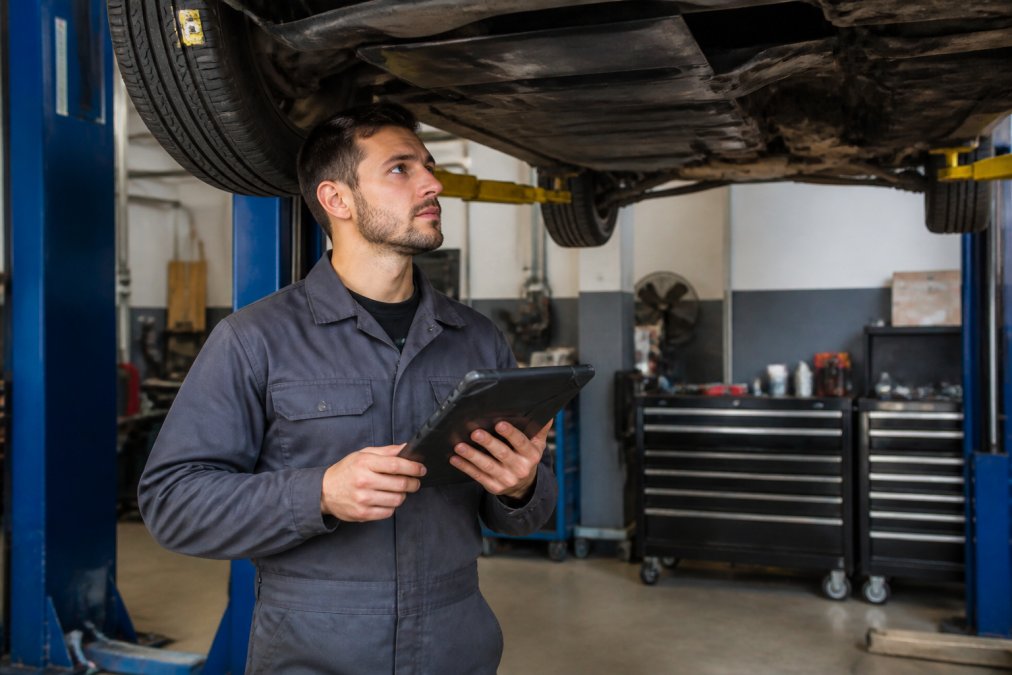
Certification covers distinct specialties, including engine repair, electrical systems, brakes, and heating and cooling. A shop with certified techs across multiple areas can handle complex, interconnected problems that a generalist might misdiagnose.
The practical benefit is fewer return visits. A technician who understands how a failing alternator affects battery and charging readings won’t replace the wrong part. You can verify a shop’s certification claims through the ASE technician certification lookup.
Routine Car Maintenance Checklist for Mesa Drivers
A routine car maintenance checklist keeps your vehicle reliable between major repairs. For most vehicles, the core schedule looks like this:
| Service | Interval | Why It Matters Locally |
|---|---|---|
| Oil and filter change | Every 5,000-7,500 miles | Heat breaks down oil faster |
| Tire rotation and pressure check | Every 5,000-8,000 miles | Heat and pavement wear tires unevenly |
| Battery test | Annually, plus before summer | Heat shortens battery life |
| Coolant check and flush | Per manufacturer, often 30,000-100,000 miles | Prevents overheating in traffic |
| Brake inspection | Every 12,000 miles | Stop-and-go driving wears pads faster |
| Cabin and engine air filters | Every 12,000-15,000 miles | Dust and pollen load up quickly |
Follow your owner’s manual first. It’s the authority for your specific make and model.
Desert Heat and Stop-and-Go Traffic: Local Maintenance Realities
Desert heat and daily traffic change maintenance timelines, and ignoring that costs money. High temperatures accelerate fluid breakdown and battery wear, while constant braking in congestion shortens pad and rotor life.
A few local adjustments worth making:
- Check tire pressure monthly, since heat and pressure swing together
- Test your battery before summer, not after it fails in a parking lot
- Shorten oil change intervals if you do mostly stop-and-go driving
- Have cooling system hoses inspected as vehicles age
The NHTSA guidance on vehicle safety and maintenance recommends checking tire pressure and tread regularly, which matters even more in extreme heat.
Red Flags That Signal a Shop Isn’t Best Rated
Warning signs show up before you pay, and catching them early saves you from a bad repair. Watch for these:
- Vague or verbal-only estimates with no itemized breakdown
- Pressure to approve repairs before a diagnosis is explained
- No visible certifications or refusal to name technician credentials
- Warranty terms that are unclear or never put in writing
- No loaner or shuttle option despite advertising one
- Unwillingness to show you the failed part
Skipping a written estimate is the most expensive mistake. Without it, you have no documented baseline, and a disputed bill becomes your word against theirs.
Dealership vs Independent Shop: What Mesa Drivers Should Know
Independent shops and dealerships both have a place, and the right choice depends on your vehicle and the job. Dealerships offer manufacturer-specific training and factory parts, which helps with warranty work and brand-new models.
Independent shops typically cost less, offer more flexible scheduling, and often provide loaner cars and personalized attention. For most routine maintenance and out-of-warranty repairs, an independent shop with certified technicians delivers the same result at a lower cost.
Performance Automotive and Tire Center is a family-owned and operated alternative built on that model: ASE-certified technicians, free estimates, free loaner cars, and a nationwide warranty on repairs. Customers like Sandra S. cite the quick service, while others describe the team as mechanics you can actually trust for honest assessments and fair pricing.
One caveat: for a repair covered under a new-vehicle warranty, the dealership is usually the right call. For everything else, a qualified independent shop is worth a serious look.
Frequently Asked Questions
How do I find a trustworthy mechanic in Mesa?
Start by checking for ASE certification, which verifies a technician passed independent testing on specific repair systems. Look for shops with a written warranty, free estimates, and recent customer reviews that mention honesty and accurate diagnosis. Visit the shop before you need emergency work. Ask how they handle diagnostics, whether they offer loaner cars, and whether they will show you the failed part. A shop that answers these questions directly is usually one you can trust with your vehicle long-term.
Are ASE-certified technicians better for car repairs?
ASE certification means a technician passed standardized exams covering specific systems like brakes, electrical, or engine repair, and maintains that credential through ongoing testing. It does not guarantee every repair goes perfectly, but it confirms a baseline of verified knowledge. For complex issues like electrical faults on older vehicles, an ASE-certified mechanic is more likely to diagnose correctly the first time. Ask the shop how many of their techs hold current ASE credentials before you book.
What should I look for when choosing an auto repair shop?
Check four things: certifications (ASE), warranty terms (nationwide coverage is stronger than shop-only), estimate policy (free written estimates reduce surprises), and loaner car availability if you cannot be without your vehicle. Read recent reviews for patterns, not just star ratings. A shop with a few detailed reviews describing honest assessments is more reliable than one with dozens of vague five-star ratings. Also confirm they handle your vehicle’s make and model before scheduling.
How often should I schedule routine vehicle maintenance?
Most vehicles need an oil change every 5,000 to 7,500 miles, tire rotation at the same interval, and a brake inspection once a year. In Mesa’s heat, battery testing every six months is wise because high temperatures shorten battery life. Coolant flushes typically fall between 30,000 and 60,000 miles depending on your manufacturer’s schedule. Check your owner’s manual for the specific intervals, and ask your shop to note upcoming services on your invoice so nothing gets missed.
Sorting through ratings, certifications, and warranty terms takes effort, but it’s the difference between a repair that lasts and one you repeat. Performance Automotive and Tire Center handles nearly every make and model with ASE-certified technicians, free estimates, and free loaner cars, backed by a nationwide warranty. Call 480-924-7444 to schedule service and get an honest assessment before you commit.
Tags: ase certified mechanics mesa, auto repair mesa, best rated auto repair mesa az, how to choose an auto repair shop, routine car maintenance checklist
