
Table of Contents
- Why Verifying Repair Estimates Matters
- What to Look for in a Written Repair Estimate
- Steps to Verify a Mechanic’s Quote
- Is a Diagnostic Fee Standard for Car Repairs
- How to Ask for a Second Opinion on Car Repairs
- Questions to Ask Your Service Advisor
- Common Mistakes to Avoid When Reviewing Estimates
- Frequently Asked Questions
Last Updated: September 28, 2026
Why Verifying Repair Estimates Matters
Getting a repair estimate from a mechanic is one of those moments where you feel vulnerable, which is why learning to verify mechanic repair estimates matters so much. You don’t know if the price is fair. You don’t know if the work is actually necessary. You don’t know if you’re being taken advantage of.
What to Look for in a Written Repair Estimate
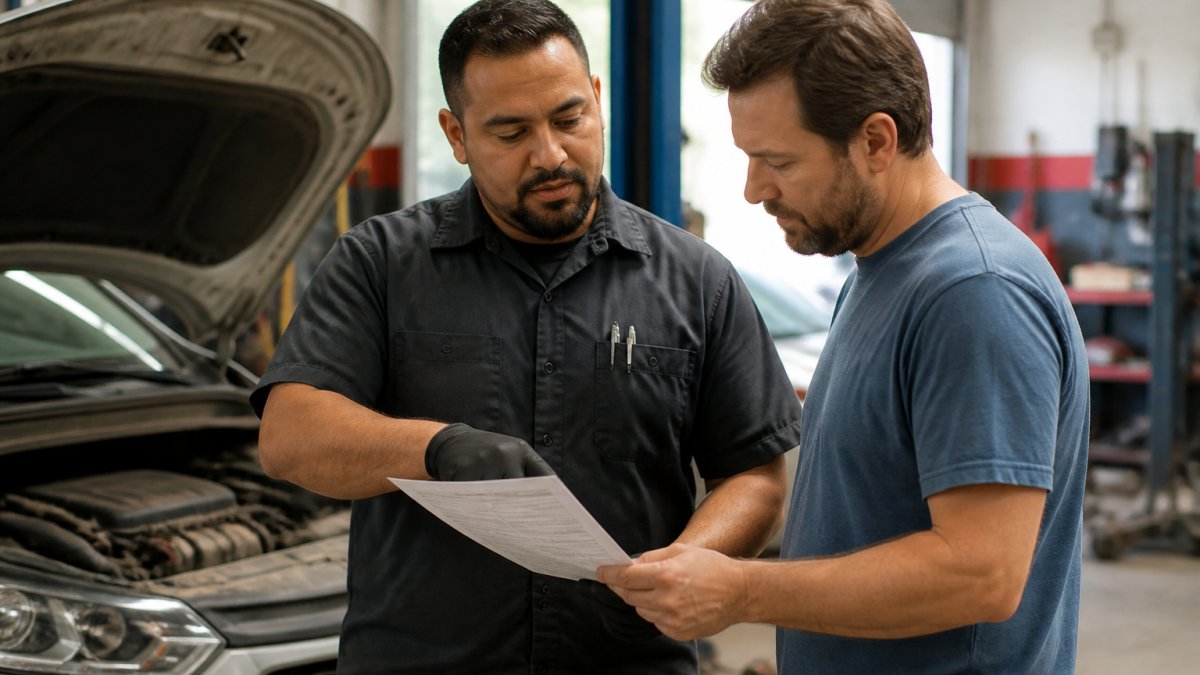
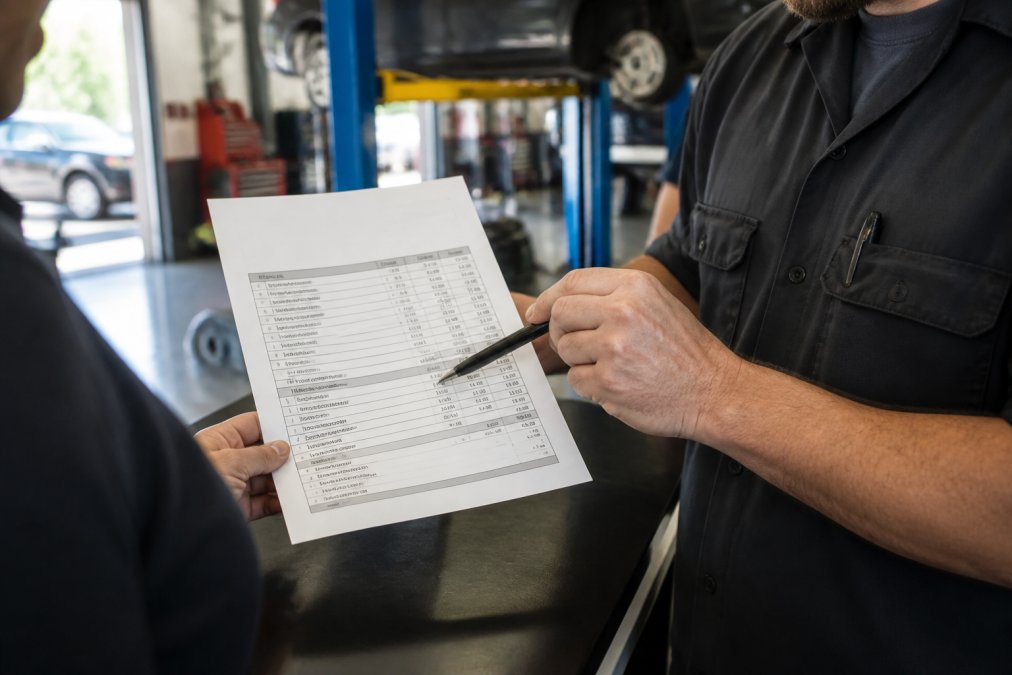
A proper written estimate is your protection. It’s a document that breaks down exactly what work will be done, what parts are needed, and what labor costs. Without it, you’re working from memory or a verbal conversation, which creates confusion and disputes.
Itemized Parts and Labor Breakdown
Your estimate should list every part separately with its cost. It should also show labor hours and the shop’s labor rate. This itemization is essential because it lets you compare prices across different shops and verify fairness.
Look for these specific details on your estimate:
- Part name and part number
- Part cost (what the shop pays for the part)
- Labor hours required for installation
- Shop labor rate per hour
- Total labor cost for that repair
- Any shop supplies or diagnostic fees
- Warranty terms on parts and labor
Red Flags in Diagnostic Reports
Diagnostic reports tell you what’s wrong with your vehicle. They’re created using computerized scanning equipment that reads your vehicle’s systems. A quality diagnostic report should explain the problem in plain language, not just error codes.
Red flags to watch for:
- Multiple unrelated problems diagnosed at once (especially if you only reported one symptom)
- Vague descriptions like “system failure” without specifics
- Recommended repairs that don’t match the diagnosed problem
- Pressure to authorize additional work beyond what you requested
- Diagnostic fees that seem excessive compared to the repair cost
Steps to Verify a Mechanic’s Quote
Verifying a mechanic’s quote involves five concrete steps. Each one takes minutes but gives you confidence in the estimate.
Step 1: Request a Detailed Written Estimate
Never accept a verbal estimate. Always ask for something in writing. A written estimate protects both you and the shop by creating a record of what was discussed.
Your written estimate should include:
- Your vehicle’s year, make, model, and mileage
- The date the estimate was prepared
- A description of the problem and recommended repairs
- Every part that will be replaced (with part numbers)
- Labor hours and the shop’s hourly rate
- Total estimated cost
- Warranty coverage on parts and labor
- How long the estimate is valid (usually 30 days)
Step 2: Check Labor Rates Against Fair Market Value
Labor rates vary by location, shop type, and technician certification level. A dealership typically charges more per hour than an independent shop. ASE-certified technicians usually command higher rates than uncertified mechanics.
Step 3: Verify OEM vs. Aftermarket Parts Impact
Your estimate should specify whether parts are original equipment manufacturer (OEM) parts or aftermarket parts. This choice significantly affects cost, warranty, and longevity, and it’s often where consumers feel confused or pressured.
OEM Parts:
- Made by your vehicle’s original manufacturer (e.g., Honda parts for a Honda)
- Guaranteed to fit perfectly; engineered to exact specifications
- Typically cost 20-50% more than aftermarket equivalents
- Covered by the manufacturer’s warranty (usually 12 months or 12,000 miles)
- Warranty is often transferable if you sell the vehicle
- Tend to have longer average lifespan and lower failure rates
- Better resale value if you’re selling a recently repaired vehicle
Aftermarket Parts:
- Made by third-party suppliers (e.g., Bosch, Dorman, Motorcraft)
- Quality varies widely; some are excellent, others are cheap and fail quickly
- Cost 30-70% less than OEM equivalents
- Warranty varies by supplier and shop (typically 12 months or 12,000 miles)
- Warranty is usually not transferable
- Average lifespan varies; budget aftermarket parts may fail sooner
- Some aftermarket parts are OEM-equivalent quality and are a smart choice
How to Make the Right Choice:
-
Ask the mechanic which parts they recommend and why. A quality shop will explain the difference and let you choose. They should tell you if they’ve had good or bad experiences with specific aftermarket brands.
-
Understand the cost-benefit trade-off. If you’re replacing a brake pad, the cost difference between OEM and quality aftermarket is small ($20-$40), so OEM makes sense. If you’re replacing a water pump on a 15-year-old vehicle you plan to sell soon, a quality aftermarket part might be the better value.
-
Ask about the specific aftermarket brand. Not all aftermarket parts are equal. Bosch, Motorcraft, and Dorman are generally reliable. Unknown brands with no reviews are riskier. If the shop can’t name the brand or justify it, that’s a red flag.
-
Consider the repair’s criticality. For safety-related parts (brakes, steering, suspension), OEM or premium aftermarket is worth the extra cost. For cosmetic or non-critical parts (trim, mirrors, door handles), budget aftermarket is often fine.
-
Factor in the warranty and your plans. If you plan to keep the vehicle for many years, OEM parts with longer warranties make sense. If you’re selling soon, a cheaper aftermarket part with a shop warranty may be acceptable.
-
Don’t assume the cheapest option is best. A failed part that needs replacement twice costs more than a quality part that lasts. A $150 OEM part that lasts 100,000 miles is cheaper per mile than a $80 aftermarket part that lasts 40,000 miles.
Step 4: Confirm Warranty Coverage on Parts and Labor
Every estimate should specify what’s covered under warranty. Parts warranties typically last 12 months or 12,000 miles, whichever comes first. Labor warranties are usually 30 days.
Ask these specific questions:
- Does the warranty cover parts only or parts and labor?
- How long is the warranty valid?
- What happens if the repaired component fails during the warranty period?
- Is the warranty transferable if you sell the vehicle?
- Does the warranty apply nationwide or only at this shop?
- Are there any exclusions (e.g., does the warranty cover wear and tear but not misuse)?
Step 5: Compare Total Cost Across Multiple Shops
Once you have detailed estimates from 2-3 shops, compare them side by side. Don’t just look at the total; break down the differences:
- Are labor rates different? If so, by how much?
- Are parts costs different? Is one shop using OEM and another using aftermarket?
- Are warranty terms different?
- Are there additional fees (diagnostic, shop supplies, disposal) that vary?
Is a Diagnostic Fee Standard for Car Repairs
Many shops charge a diagnostic fee to identify what’s wrong with your vehicle. This fee covers the cost of connecting diagnostic equipment, running tests, and analyzing results. A typical diagnostic fee ranges based on complexity, but shops should disclose this fee upfront.
How to Ask for a Second Opinion on Car Repairs
When a repair estimate surprises you or seems excessive, a second opinion is wise. Getting a second opinion doesn’t insult your mechanic. It’s smart consumer behavior.
Here’s how to approach it professionally:
- Tell your current mechanic you’d like a second opinion before authorizing major work
- Ask if they can email or print the diagnostic report so you can share it with another shop
- Visit another qualified shop and show them the original estimate and diagnostic report
- Ask the second mechanic if the recommended repairs match the diagnosis
- Compare labor rates, parts costs, and warranty terms between shops
Questions to Ask Your Service Advisor
Your service advisor is your connection to the mechanic. They explain the work, answer your questions, and handle your concerns. Asking the right questions ensures clear communication.
Before authorizing any repair, ask these questions:
- What specifically is broken and why does it need repair?
- What will happen if I don’t make this repair right now?
- Are there temporary solutions or less expensive alternatives?
- How long will this repair take?
- Will my vehicle be drivable while it’s being repaired?
- What’s your labor rate per hour?
- Do you use OEM or aftermarket parts, and what’s the difference in cost?
- What warranty covers this repair?
- Will you contact me before proceeding if costs exceed the estimate?
- Can you show me the damaged part after it’s removed?
Common Mistakes to Avoid When Reviewing Estimates
Most vehicle owners make predictable mistakes when reviewing repair estimates. Knowing these mistakes helps you avoid them.
| Mistake | Why It Matters | What to Do Instead |
|---|---|---|
| Accepting the first estimate without comparison | You might pay 20-30% more than fair market value | Get 2-3 estimates for major repairs |
| Ignoring the diagnostic report | You won’t understand what’s actually broken | Ask for plain-language explanations |
| Assuming the cheapest estimate is best | Low-cost shops may use poor-quality parts or rush work | Compare quality, warranty, and reputation equally |
| Not verifying labor rates | You can’t tell if hourly charges are fair | Research local rates for your vehicle type |
| Skipping the written estimate | Verbal agreements create confusion and disputes | Always request documentation in writing |
| Overlooking warranty terms | You won’t know what’s covered if something fails | Confirm warranty length and coverage scope |
| Authorizing extra work without understanding it | You might pay for unnecessary repairs | Ask why each repair is needed before approving |
| Not asking about parts quality | You might get cheap parts that fail quickly | Request OEM or quality aftermarket parts |
Frequently Asked Questions
What should a written repair estimate always include?
A written repair estimate must list itemized parts with costs, labor hours and rates, a vehicle identification number (VIN), the repair facility’s name and contact information, and an estimate validity date. It should break down the cost of each component separately and specify whether parts are OEM or aftermarket. A reputable repair facility provides this in writing before starting work, protecting both you and the shop.
How do I know if a diagnostic fee is reasonable?
Diagnostic fees typically range from $75 to $150 depending on complexity. Always get the diagnostic fee in writing before work begins.
When should I ask for a second opinion on car repairs?
Request a second opinion if the estimate seems unusually high, involves major disassembly or hidden damage claims, or if you’re unsure about the diagnosis. It’s standard practice and protects your investment. Bring the original estimate to the second facility so they can compare findings. This is especially wise for electrical issues or transmission work, where misdiagnosis is common.
What’s the difference between OEM and aftermarket parts, and does it affect the estimate?
OEM (Original Equipment Manufacturer) parts are made by your vehicle’s manufacturer and typically cost more but carry the manufacturer’s warranty. Aftermarket components are made by third parties and usually cost less with varying warranty coverage. Your estimate should clearly state which type is being used. OEM parts may be required for warranty coverage on newer vehicles, while aftermarket options work well for older vehicles when cost matters.

